Plastic Surgery: Not Child’s Play
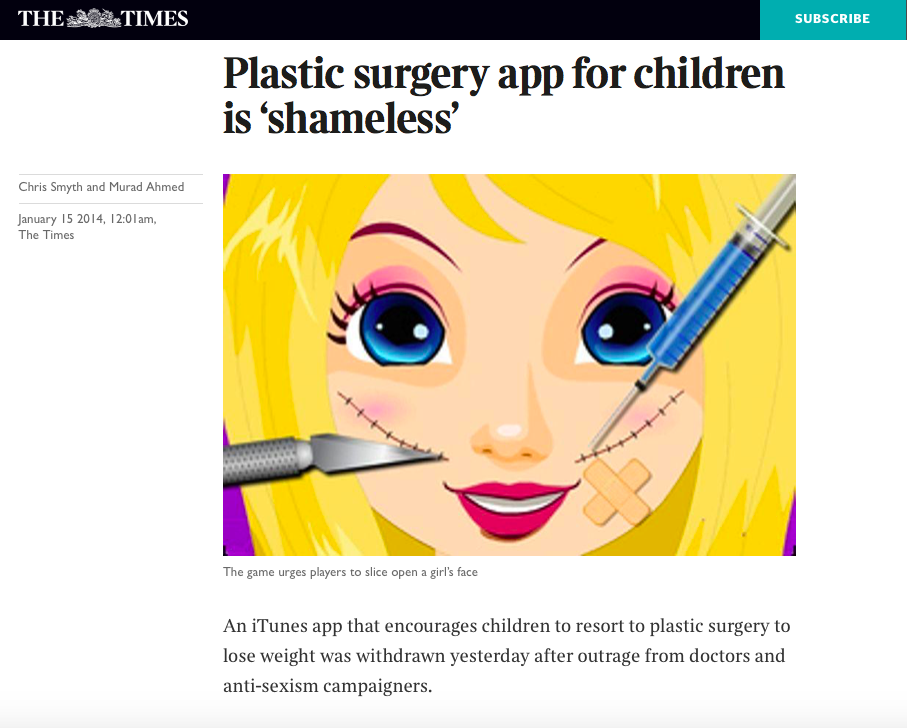
In 2014, in working with the British Association of Aesthetic Plastic Surgeons (BAPRAS) as their day-to-day press officer and social media manager, I pitched a story to Times Journalist Chris Smyth about the shameless proliferation of apps designed as games for children – even brazenly replicating beloved Disney characters to do so. Whilst this (rightly) received attention in the press, raising public awareness about a dangerous phenomenon often requires more than the traditional approaches, especially in digital spaces.
In order to do this, I elected to use April Fools Day to create a social media stunt that generated widespread attention within the UK Aesthetic market and beyond it. After coming clean about the “prank,” I created threads to raise further awareness among a following of surgeons, doctors nurse injectors, prescribers as well as health and beauty influencers, so that these audiences could easily share them to audiences worldwide.
It was so well received that I was invited to co-author The Last Word in one of the industry’s most prominent journals, detailing the issue, as well as the prank. This, in addition to my long history of work in the sector established my reputation within the industry as a social media (and prank) expert.
The Last Word: Cosmetic Games
04 MAY 2016|
Tingy Simoes and Nikki Milovanovic argue why it’s time to clamp down on cosmetic games aimed at children.
On April 1, the British Association of Aesthetic Plastic Surgeons’ (BAAPS) press office engaged in the time-honoured tradition of spaghetti trees and flying penguins bylaunching an April Fools’ Day prank through social media. The stunt took the form of an image of a plastic doll accompanied by syringes and surgical instruments, marketed as a toy for girls.
Whilst clearly meant to be light-hearted, the reasoning behind it was anything but. The ‘doctored’ image, posted through the BAAPS press office Twitter account, had the express purpose of shocking the aesthetics sector into realising there is a very real problem with a new spate of cosmetic surgery and non-surgical ‘games’ aimed at children.
The post managed to ‘fool and sparked hot debates on body image, psychologically vulnerable groups and advertising. As absurd as it might seem, the pretend toy is sadly only one small manufacturing step away from the games already deemed marketable in a sector with little statutory controls – a sector that quite often sees untrained practitioners performing injectable treatments on young patients.
In the aftermath of the prank, when (according to custom) the BAAPS media team came clean at noon, we followed up with a series of actual, real ‘games’ we’d found online and through app stores in order to raise awareness of the problem. Marketed as girls’ games designed for ages nine and above, they had slogans such as ‘a game for beauty and skin operations to make princess look beautiful’ and ‘little boys and girls it’s your chance to become an expert doctor. An even more graphic pastime marketed at girls aged 12+ showed cartoon patients undergoing rhinoplasty, accompanied by the message ‘every girl dreams of (sic) delicate face and stunning figure. If makeup can’t give the beauty you want… turn into a Victoria’s secret (sic] model at oncel Players of the game can also alter ‘unsatisfactory boyfriends, who will become ‘a handsome male model immediately!”
Some of the apps even went so far as to pirate highly recognisable Disney characters from the movie Frozen, with the protagonists discussing liposuction due to ‘being fat. Perhaps in today’s society one could argue children are hardly unaware of the term fat – but why introduce them to a ‘need’ for liposuction so early in life?
 Sophisticated Comms
